Why Simple Games Never Go Out of Style (6 Reasons)
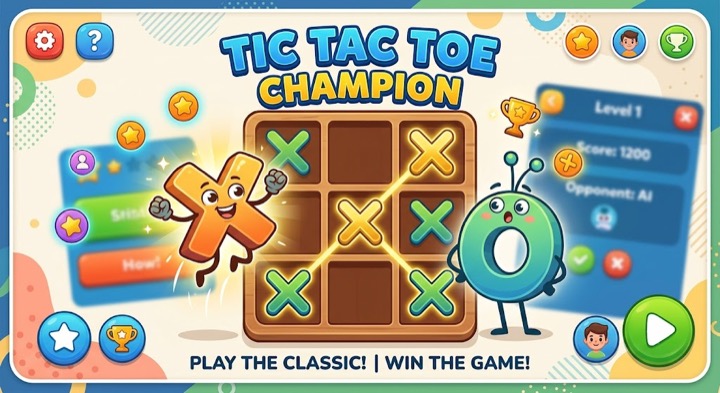
Your phone can run games with film-quality graphics, huge open worlds and online battles with players across the planet. And yet, on any given day, millions of people use that same phone to slide numbered tiles around a grid or guess one five-letter word.
That isn’t an accident or a passing trend. It has happened again and again for decades, and arguably for thousands of years.
Simple games last because they take seconds to learn, fit into any spare moment, ask nothing of the player, and still hide enough depth to stay interesting. Graphics age quickly, but good rules don’t.
Here’s the pattern, and the six reasons behind it.
The Pattern: Simple Hits Keep Coming Back
Look at some of the most widely played games in history, and a theme stands out:
| Game | When | What made it spread |
|---|---|---|
| Tic Tac Toe | Three-in-a-row boards date back to around 1300 BC in Egypt | A grid you can draw anywhere |
| Memory (card matching) | Published in its modern form in 1959 | Rules a 3-year-old can follow |
| Windows Solitaire | Included with Windows 3.0 in 1990 | Already on millions of computers |
| Snake | Nokia 6110, 1997 | Built into a phone people already owned |
| 2048 | Released free on the web in March 2014 | One tab, no install, four arrow keys |
| Wordle | Launched October 2021 | One puzzle a day, shared with friends |
None of these are technical showpieces. Several were built by one person, sometimes almost by accident. 2048 was made by a 19-year-old developer, Gabriele Cirulli, in about a weekend, as a test of whether he could build a game from scratch. It drew more than 4 million visitors in under a week.
Wordle began even smaller. Josh Wardle made it for his partner, who loved word games. It had 90 players on November 1, 2021, about 300,000 two months later, and soon millions, before The New York Times bought it in early 2022.
So what do these games have in common?
1. You Learn Them in Seconds
The best simple games pass what you could call the “over the shoulder” test. Someone watching you play for ten seconds understands the game well enough to try it.
Swipe to merge matching numbers. Get three in a row. Flip two cards and find the pair. There’s no tutorial, no manual, and no 20-minute introduction before the fun starts.
That matters more than it seems. Every rule a game adds is another reason for a new player to give up. Simple games keep that barrier so low that almost anyone, from a young child to a grandparent, can join in.
2. They Fit the Gaps in Your Day
Big games ask for big blocks of time: an evening, a weekend, a long session with headphones on. Most of life doesn’t come in those blocks. It comes in five-minute gaps: waiting for a bus, a queue at the bank, the end of a lunch break.
Simple games are built for those gaps. A round of Tic Tac Toe takes under a minute. A game of 2048 takes a few minutes. Wordle goes further and gives you only one puzzle a day, so it can never take over your afternoon.
The short round is the whole point, not a limitation.
3. Simple Rules Can Hide Surprising Depth
“Simple” doesn’t mean “shallow.” Some of the easiest games to learn turn out to be surprisingly deep.
Tic Tac Toe has 255,168 possible games, and mathematicians have proven that perfect play from both sides always ends in a draw. Learning why is a small lesson in strategy: block every threat, and never let your opponent create two at once.
2048 is another example. Anyone can merge two tiles, but reaching the 2048 tile consistently takes real planning: keeping your highest tile in a corner and building a chain of descending numbers toward it.
That combination of easy to start but hard to master is what keeps people coming back for years, not just days.
4. Graphics Age, Rules Don’t
Think about how dated the cutting-edge games of 2005 look now. Graphics that amazed people back then often look clumsy today, because technology keeps raising the bar.
Simple games mostly avoid this problem. Snake on a monochrome Nokia screen is still recognizably Snake. A Tic Tac Toe grid looks the same whether it’s chalked on a pavement or rendered in neon on a phone. The idea is the game, so there’s nothing to go out of date.
This is why simple games get rebuilt again and again on every new device. Each new platform needs its own version of solitaire, its own version of Snake, its own Memory game. The rules carry over untouched.
5. They’re Social Without Trying
You don’t need voice chat or a team to make simple games social.
Tic Tac Toe is usually someone’s first two-player strategy game. Memory is one of the rare games where a young child can genuinely compete with an adult. And once Wordle took off, one puzzle a day meant everyone was solving the same word, which gave friends, families and coworkers something easy to talk about.
Simple games create shared moments because everyone already knows how to play.
6. They Ask Nothing of You
The most underrated advantage of simple games is how little they ask before you can start.
When Microsoft added Solitaire to Windows 3.0 in 1990, part of the reason was to help nervous users get comfortable with the new graphical interface and practice using a mouse. The game was simply there, already installed, waiting.
2048 followed the same principle online. It was free and open source, ran in a browser tab, and needed no account or download. Removing every barrier between a person and the first move is often what turns a small game into a global hit.
What This Means for How We Play Today
Today’s devices are more powerful than ever, but people’s time and attention haven’t grown with them. If anything, the five-minute gaps in a day matter more now, because they’re often the only quiet moments people get.
That’s why browser games that load instantly, need no sign-up, and finish in a few minutes still have a place. Sites like Online Timepass Games exist for exactly this reason: classic games like 2048, Tic Tac Toe and Memory Match, ready the moment you need a short break.
The Takeaway
Simple games keep coming back because they fit how people actually live: in short gaps, on whatever device is nearby, with no time for a tutorial. Graphics will keep improving, and big games will keep breaking records. But the next global craze is just as likely to be a grid, a few tiles, and one clever rule.
7. FAQs
Why are simple games so popular?
They’re quick to learn, fit into short breaks, work on almost any device, and often hide enough strategy to stay interesting for years.
What is the most popular simple game of all time?
There’s no single agreed answer, but Tic Tac Toe, solitaire, Snake, 2048 and Wordle are among the most widely played simple games in history.
Who created 2048?
Gabriele Cirulli, an Italian web developer, released 2048 in March 2014 at age 19. He built it in about a weekend and released it free and open source.
Why did Microsoft include Solitaire in Windows?
It was added to Windows 3.0 in 1990, partly to make new users comfortable with the graphical interface and to help them practice using a mouse.
Are simple games good for your brain?
They exercise attention, memory and planning while you play, but research doesn’t show that they improve general intelligence. Treat them as fun and relaxing, not as brain training.

About Premium Author
This post has been authored and published by one of our premium contributors, who are experts in their fields. They bring high-quality, well-researched content that adds significant value to our platform.


Popular Categories
Stay Connected
Recent Posts